Why Your Security Tools Are Costing You Twice as Much
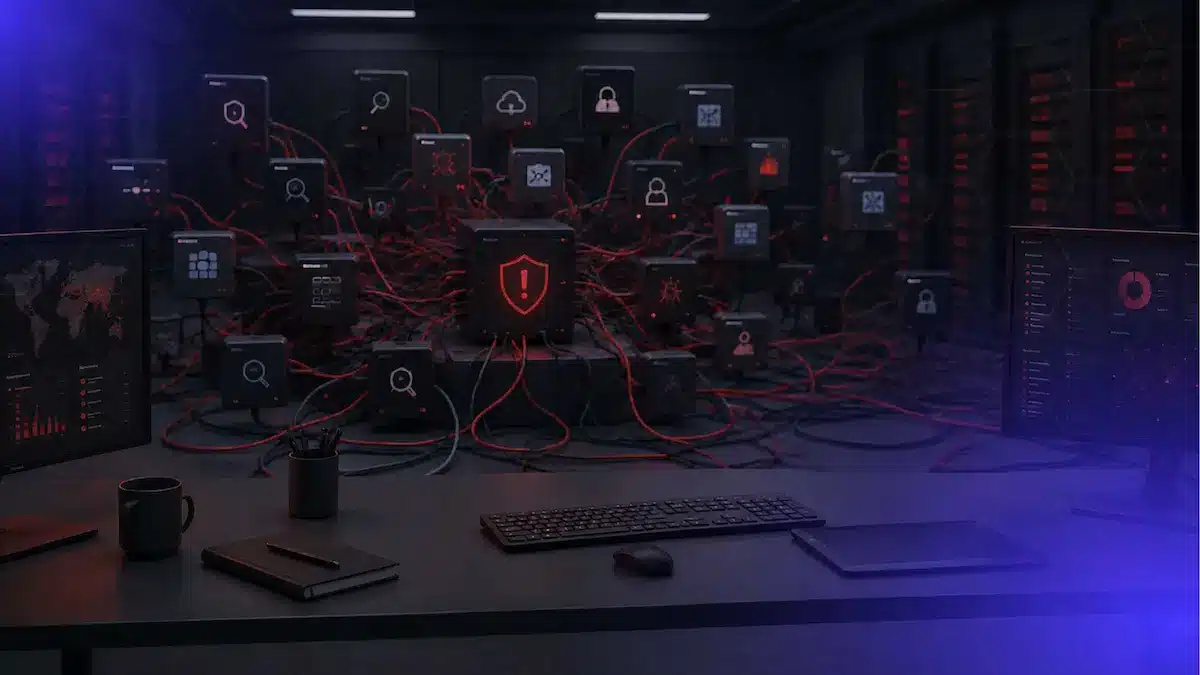
Each tool was likely bought to close a specific gap, and each one probably does its job. The issue isn’t that these tools are ineffective, it’s that they were never designed to operate as a single system. Connecting products through APIs or integrations doesn’t create a unified security architecture. It simply connects separate products that still operate independently.
For a Lean IT team, that disconnection is a compounding drain on budget, time, and attention.
Gartner® states “Because large enterprises use an average of 43 security tools, cybersecurity leaders are looking to reduce the number of security vendors in their network security protection portfolio.”[1] That might sound like comprehensive protection. In reality, it’s often the opposite. More tools don’t necessarily create more security. Instead, they create more complexity, more operational overhead, and more opportunities for gaps between them. Forty-three isn’t the story. Fragmentation is.
Where the money actually goes
Vendors can be easy to add, but complexity is much harder to remove. Once a stack fragments, the cost surfaces in four places:
Licensing waste. Gartner reports that “cybersecurity leaders waste up to 30% of their tool budgets on tools that are never deployed or fully utilized.”[2] For a team spending $500,000 a year on security software, that’s $150,000 sitting on a shelf.
Integration overhead. Every added tool creates new integrations to maintain, new telemetry to process, and new opportunities for misconfiguration. Gartner’s research on this finds that “Beyond the “double license,” overlapping tools often generate duplicate alerts (including false positives), contributing to the alert fatigue and blurring the real picture of threats.” Gartner projects that “by 2028 the average enterprise will waste between 35% to 40% of the total SOC budget due to overlapping hidden costs.”[3]
Training time. Every console has its own logic, its own dashboard, its own learning curve. Onboarding a new hire across eight or more separate tools can take months. Institutional knowledge lives with whoever configured each one, and it walks out the door when they do.
Staff burnout. Alert fatigue is the most visible symptom of tool overlap, but it’s also the most expensive. When signals don’t connect across tools, real threats disappear into the noise, and the analysts responsible for catching them burn out trying.
The real toll on a lean team
The biggest hidden expense isn’t another software license. It’s the people required to keep dozens of disconnected tools functioning together.
While large enterprises may manage as many as 37 security tools, lean IT teams typically rely on a half dozen or so, yet still face the same fragmentation, complexity, and visibility gaps.
Put numbers on it, and the picture sharpens fast. Based on CORO analysis of typical Lean IT team structures, a team of four people managing a stack of eight to 10 tools loses roughly 2.5 FTE of capacity to tool care and feeding: vendor coordination, alert triage, configuration review, and integration troubleshooting.
At a cost of around $100,000 per analyst, that’s $250,000 or more a year spent managing tools instead of managing risk. Layer the licensing waste on top, and fragmentation can easily cost a lean team half a million dollars annually, all to run a stack that still can’t see across itself.
Lean IT team
Total capacity
4 FTE
Lost to tool overhead (vendor coordination, alert triage, config review, integration troubleshooting)
2.5 FTE
Left for actual security work
1.5 FTE
Annual cost of that overhead
$250,000+
Licensing waste (unused or underused tools)
$150,000
Total annual cost of fragmentation
$400,000+
What changes when the stack consolidates
Enough organizations hit this same wall that a new category has emerged to address it. Gartner states that “the workspace cybersecurity platform (WCP) offers a set of modular, preintegrated product capabilities designed to protect the endpoints, identities, applications, and data of modern digital workers. Key modules include device protection, identity protection, data loss prevention, and controls for end-user applications such as email, browser, and client-side apps running on the endpoint, as well as AI usage discovery and control.”[4]
Gartner’s guidance for executing a cohesive strategy points organizations to “consolidate commoditized tools into platforms that offer preintegrated product modules for digital worker-centric protection, including endpoint protection, EDR, identity threat detection and response, secure enterprise browser, email security, and data loss prevention.”[5]
Take a look at the difference between a fragmented stack and workspace cybersecurity platform side by side:
Fragmented stack
Workspace cybersecurity platform
Admin consoles to monitor
12–15
1
Endpoint agents deployed
4–6
1–2
Policy update time
1–2 weeks
1–2 days
FTE lost to tool overhead
2.5
0.5–1
Annual cost of that overhead
$250,000+
$50,000-100,000
That’s $150,000 to $200,000 a year back on staff time alone, before a single license gets cancelled.
The return on consolidation is time and reduced chaos
It’s worth being precise about the terms here: workspace cybersecurity is the target, meaning the protection of a digital worker’s devices, identity, data, and applications, wherever that work happens. A workspace cybersecurity platform is the architecture that makes that target operationally sustainable. It’s the thing a team actually buys and runs day to day.
Gartner projects that “cybersecurity platforms will replace ‘best of breed’ siloed buying for 75% of organizations”.[6]
Consolidation isn’t just about reducing software licenses. It’s about reclaiming the time your team spends managing complexity instead of improving security.
Every hour spent coordinating vendors, maintaining integrations, or triaging duplicate alerts is time that can’t be invested in strengthening your security posture. Workspace cybersecurity consolidation helps return that time to the people who need it most.
Want the full framework? Download The Workspace Cybersecurity Imperative for Lean IT Teams for a practical framework for evaluating workspace cybersecurity consolidation and reducing tool sprawl while reclaiming valuable staff capacity.
Sources
[1] Gartner, Maximize Network Security Platform Investments by Enabling Advanced Features, Adam Hils and Charanpal Bhogal, March 2026
[2] Gartner, Quantify the Cost of Microsoft Defender Suite When Consolidating Workspace Security Providers” Ashish Suraj Bhan, Evgeny Mirolyubov and Craig Lawson, 23 June 2026
[3] Gartner, Manage SOC Tool Overlap to Avoid Hidden Expenses, Carlos De Sola Caraballo, 9 March 2026
[4] Gartner, Market Overview for Workspace Cybersecurity Platforms,” Evgeny Mirolyubov, Peter Firstbrook, 20 July 2026
[5] Gartner, 3 Steps to Execute a Cohesive Workspace Cybersecurity Strategy,” Evgeny Mirolyubov and Chris Silva, 15 July 2026
[6] Gartner, 5 Steps to Rationalizing Your Cybersecurity Technology Stack by 2030, Peter Firstbrook, 7 July 2026
GARTNER is a registered trademark and service mark of Gartner, Inc. and/or its affiliates in the U.S. and internationally and is used herein with permission. All rights reserved. Gartner does not endorse any vendor, product or service depicted in its research publications, and does not advise technology users to select only those vendors with the highest ratings or other designation. Gartner research publications consist of the opinions of Gartner’s research organization and should not be construed as statements of fact. Gartner disclaims all warranties, expressed or implied, with respect to this research, including any warranties of merchantability or fitness for a particular purpose.