It Has a Scale Problem.
The architecture holds, until the complexity of your tool stack starts to compress your team’s focus and capacity. Here’s what’s actually breaking, and what to do about it.
If you’ve reached the point where managing your stack feels like a full-time job, you’ve probably felt this already.
MSP growth isn’t a one-time event. You add customers, and with each one, you inherit more tools. That model works until the complexity of your security service stops scaling with your business.
You built something solid. Good tools. Reasonable coverage. A team that knows how to use them. But then the stack grew.
Somewhere along the way – whether you’re managing 5 large customers or 50 smaller ones, something shifted. Not dramatically. No single breaking moment. Just a slow accumulation of friction: hard to name, impossible to ignore.
Alert volumes climb. Engineers spend more time navigating tools than resolving issues. A customer asks why it took hours to understand an incident that started with a single phishing email. You start questioning the tools, the team, the process.
But it’s none of those.
What breaks first at scale is protection for your customers.
The architecture was never designed to scale with you.
Most security stacks weren’t designed to work in unison, as a collective. They were assembled as point solutions.
An endpoint tool here. An email gateway there. A cloud monitor added after a near-miss. A SIEM layered in to make sense of it all.
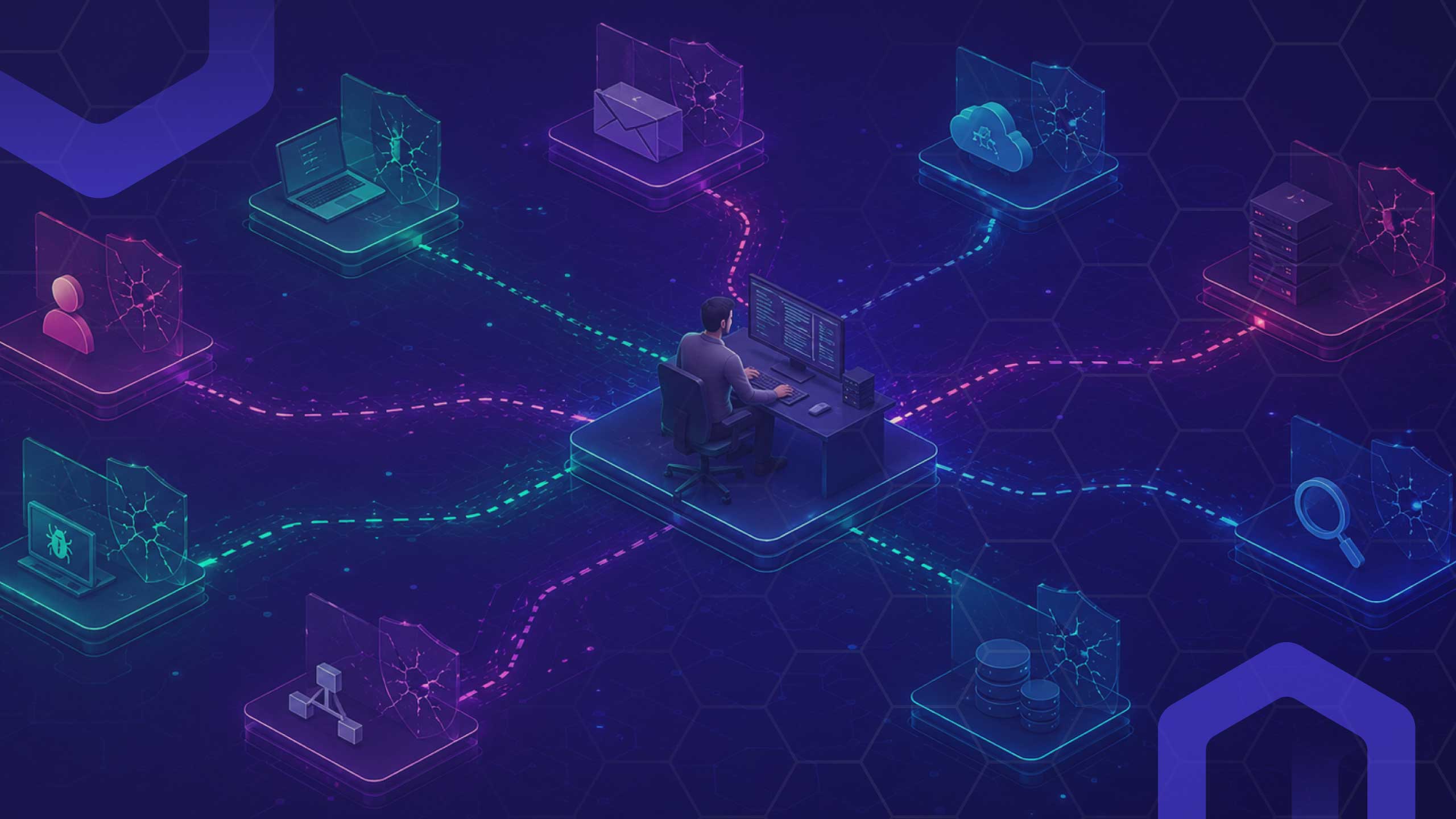
Each tool works, but it’s not integrated. The problem isn’t what each tool sees; it’s what none of them see together. Modern attacks exploit that gap. They move across surfaces like email, endpoint and cloud, fragmenting themselves so no single tool sees the full picture. What should be one incident becomes many. Separate alerts and consoles with no shared context.
According to Forrester, a single coordinated attack can generate 5,000+ alerts in a fragmented environment. For one customer, that’s a problem. Across dozens, it’s a ceiling. At MSP scale, that doesn’t just create noise. It defines how many customers your team can realistically support. Because every alert still requires attention, from triage and correlation through resolution.
At MSP scale, alert volume isn’t noise. It’s a capacity constraint.
What looks like volume is actually fragmentation. The same attack, broken into pieces, forcing your team to detect, contain and remediate as quickly and efficiently as possible. That doesn’t scale if the work keeps compounding.
This is where most practices try to solve it, and why it doesn’t work.
As the customer base and tool stack grows, the instinct is to add engineers. More customers means more environments. More alerts. More consoles to manage. For a while, it works. Then the same friction returns. You’re still adding customers, but each one takes more effort to support than the last.
At a certain point, you’re not scaling a service. You’re scaling the effort required to hold it together.
Hiring doesn’t fix the problem, it only delays it. The constraint isn’t the team; it’s the architecture. Every new customer adds more configuration, integrations, and dependency on specific knowledge.
Onboarding slows down. Every new environment takes longer to stand up because the system isn’t repeatable. It’s simply reconstructed. The practice that ran smoothly now starts grinding, because nothing was designed to scale this way.
Even when teams recognize the problem, the next move is predictable.
Integration.
A lot of practices start by connecting the tools, aggregating alerts, and layering some kind of automation on top of it. It feels like progress at the beginning. But loose integration doesn’t eliminate complexity, it only relocates it.
Loose integration doesn’t solve the problem. It transfers ownership of it to your team.
Now your engineers are responsible for maintaining connections, rebuilding workflows, and translating between systems. Over time, the architecture becomes the workload. Every place your engineers are stitching together signals manually is a place the system is breaking.
This is where consolidation gets misunderstood.
Most discussions focus on replacement: which tools go away, and what gets consolidated.
But, the real question is how a completely unified platform can become the system your practice runs on. Because scale in an MSP isn’t about tools.
It’s about things like repeatability, reliability, and consistency.
If your platform can’t operate as a system, you’re still building one yourself; just incrementally.
A unified platform changes the equation. When alerts are resolved across surfaces automatically, that’s capacity returned. When incidents are understood as single events and not fragmented alerts, response time improves in ways customers notice. When posture is embedded in the system and not carried by individuals, turnover stops creating risk.
It doesn’t replace expertise. It removes the noise that prevents your team from using it effectively.
The goal isn’t less work. It’s better work.
The growth model changes.
With the right architecture, growth starts behaving the way MSPs expect it to. Adding customers doesn’t increase complexity at the same rate. The service becomes repeatable. And the team can shift focus to more impactful and meaningful services.
Growth shouldn’t make your business harder to run. If it does, the system is the problem.
That’s when the model starts working. Expanding stronger and longer-term relationships with customers, not simply adding them to your roster. All while delivering higher-value services.
If your team is spending more time coordinating tools than reducing risk across customer environments, the constraint isn’t your people. It’s the system they’re working inside. And the first step isn’t replacing tools. It’s identifying where the system breaks, where context is lost, signals don’t connect, and your team becomes the integration layer.
Consolidation doesn’t start with tools. It starts with recognizing the system itself needs to change.