For most of the last two decades, security meant protecting the endpoint. That was enough when “the endpoint” meant a company laptop, sitting inside a company network, running company-approved software.
The Gartner® 2024 Digital Worker Survey found that “nearly one-third of digital workers use a mix of six different devices, including personal devices, work-provided laptops, desktops and mobile phones, as well as virtual desktops accessed through thin clients or other computers.”[1] Most of that work happens in a browser tab or a cloud app that never touches a managed device the way a company laptop once did. The endpoint didn’t change. The way people work around it did.
As the modern workspace expanded beyond managed devices to identities, cloud applications, browsers, collaboration tools, and AI, protecting the endpoint alone stopped providing a complete picture of organizational risk.
That is the gap a newer category of tools set out to close.
What workspace cybersecurity means
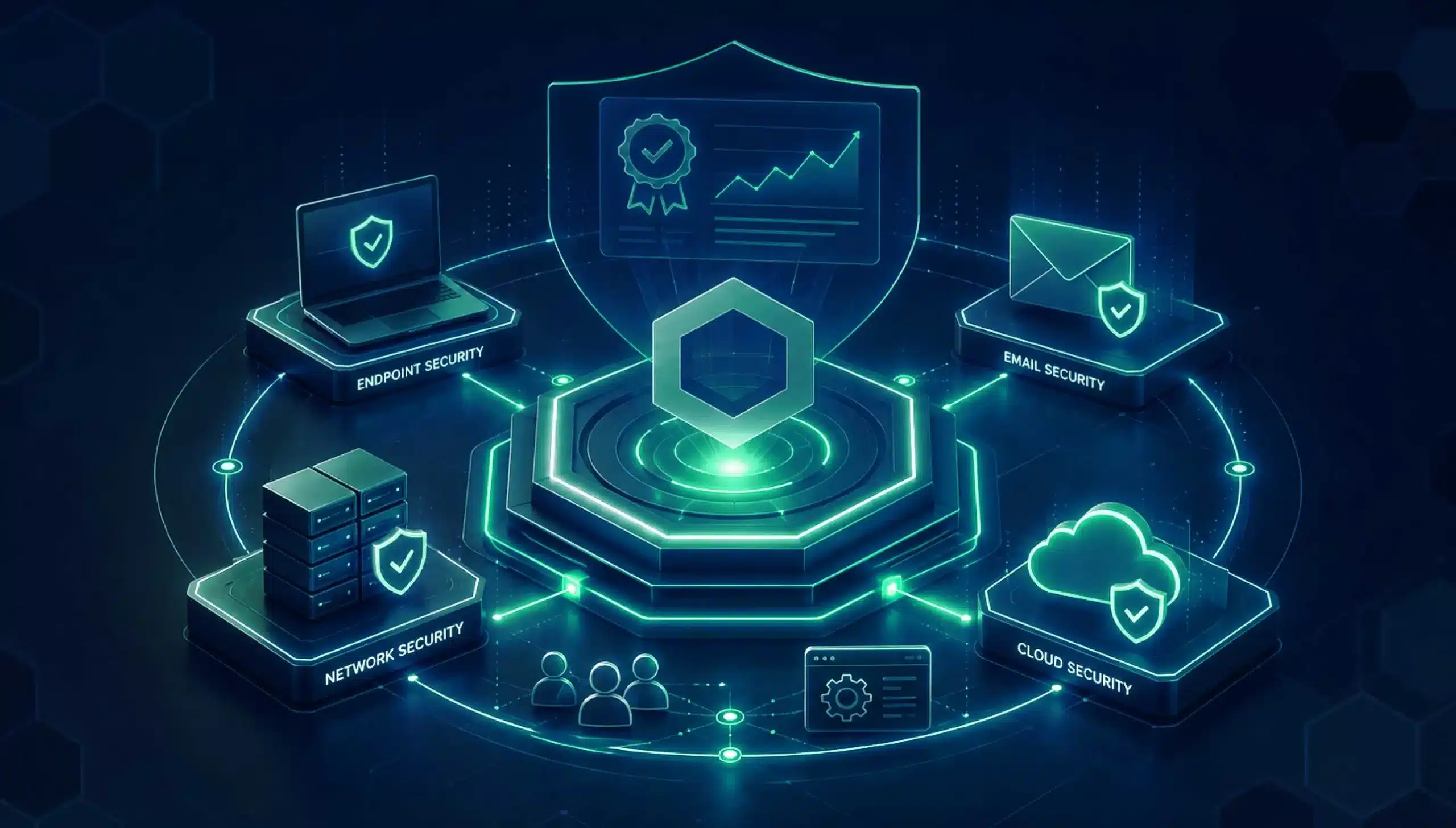
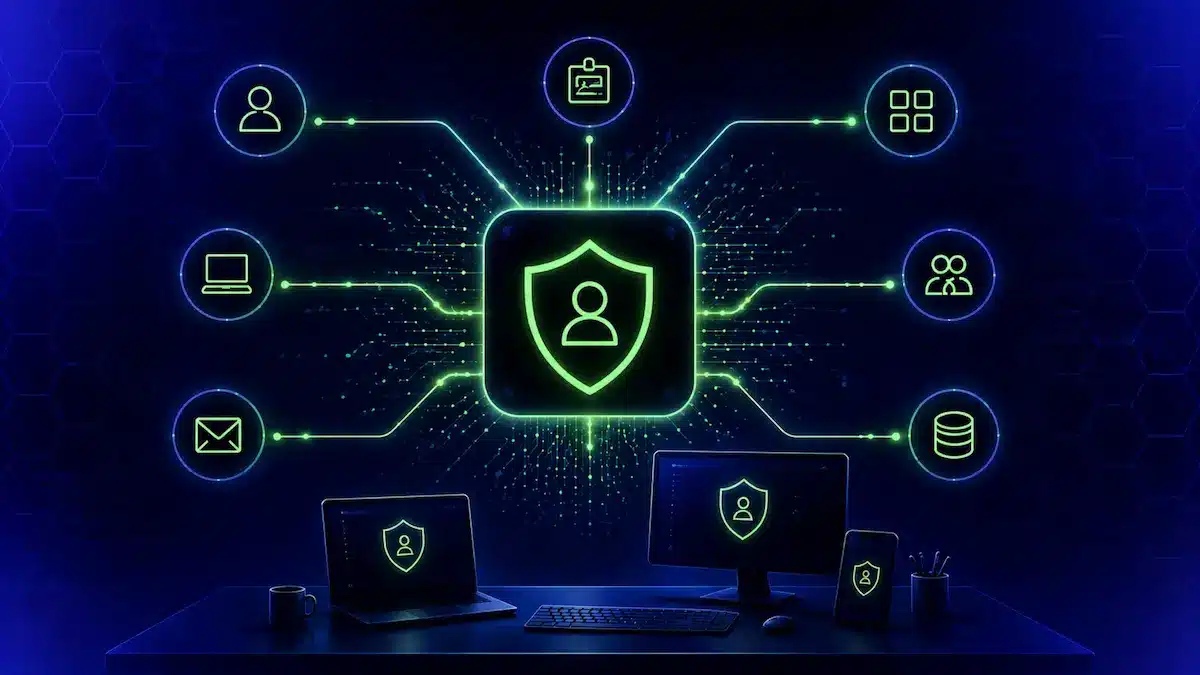
Workspace cybersecurity is an integrated, workforce-centric approach that protects the people, devices, identities, email, applications, collaboration tools, and data that make up the modern digital workspace. Instead of securing one thing (a laptop, a server, a mailbox) in isolation, it secures how a person actually works.
According to Gartner, “The workspace cybersecurity platform (WCP) market offers a set of modular, preintegrated product capabilities designed to protect the endpoints, identities, applications, and data of modern digital workers. Key modules include device protection, identity protection, data loss prevention, and controls for end-user applications such as email, browser, and client-side apps running on the endpoint, as well as AI usage discovery and control.”[2]
In practical, plain-English terms, that means protecting the device itself, verifying the person behind each login, stopping sensitive data from walking out the door, and keeping watch over everyday tools like email and the browser. It also covers newer ground: discovering and governing how employees use AI.
The distinction that matters most here is preintegration. Gartner states: “Deep integration across all natively provided modules and product layers distinguishes leading WCPs from loosely coupled suites of cybersecurity products.”[2] That’s an architectural difference, not simply an integration strategy.
Where endpoint-only security falls short
Endpoint tools were built to watch one surface: the device. Everything happening in a browser tab, an identity provider, or a cloud storage account sits outside that view. Each individual security tool may perform its own function well, but no single point solution has visibility across the entire workspace.
Here’s where each pillar’s blind spot shows up:
Pillar
What It Protects
The Gap in Endpoint-Only Security
Endpoint
Managed devices
Stops at the device boundary. Blind to anything happening in the cloud.
Identity
Credentials and access
Stolen credentials don’t need to touch a device at all.
Apps
SaaS, browsers, AI tools
A growing share of the workday happens inside a browser tab or SaaS session an endpoint agent was never built to see.
Data
Cloud and local information
No way to catch data leaving through a personal cloud account or an ungoverned AI tool.
A traditional endpoint tool does one of these well. Workspace cybersecurity is built to do all four, from the same data model, at the same time.
Why consolidation is the real advantage
The value of workspace cybersecurity isn’t simply reducing the number of tools. It enables threats to be investigated across domains, responses to be coordinated from one place, and day-to-day security operations to become significantly simpler.
A phishing email slips past the filter. Twenty minutes later, someone logs in from a device nobody recognizes. An hour after that, a file leaves through a personal cloud account.
In a fragmented stack, that’s three unrelated, low-priority alerts sitting in three different tools. In a workspace cybersecurity platform, it’s one attack, read as a sequence, because the identity, endpoint, and data signals all live in the same system. According to Gartner, a well-architected platform “correlates telemetry across devices, identities, applications, and data to enable integrated, customizable behavioral monitoring, improving threat detection and reducing false positives.”[2]
Isn’t this just EDR?
The short answer is no. Endpoint detection and response is a real, necessary capability, and it is part of workspace cybersecurity. But EDR only ever sees what happens on the device. It has no visibility into a stolen credential used from a browser, or a file that never touched an endpoint on its way to a personal cloud account.
EDR is a component of workspace cybersecurity, not the foundation. The foundation is correlation across everything a worker touches.
Traditional endpoint security remains an important part of a security strategy, but it’s only one part of protecting today’s digital workspace.
Workspace cybersecurity keeps expanding
Workspace cybersecurity is evolving. Gartner identifies three trends driving that shift:
Accelerating AI adoption: “The rapid adoption of AI, both approved and unsanctioned, has increased the risk of data loss to AI services on corporate endpoints and beyond.”
Persistent credential abuse: “A high volume of credential abuse attacks as an initial access vector drives the need for identity threat detection and protection.”
Cybersecurity rationalization: “Most cybersecurity leaders seek to rationalize strategic vendors and simplify their tool stack to reduce complexity and optimize costs.”[2]
Two capabilities are quickly becoming table stakes as a result. The first is AI usage governance — discovering which AI tools employees are actually using, sanctioned or not, and enforcing policy around what data can and can’t go into them. The second is identity threat detection and response, or ITDR, which extends detection beyond the device to the credentials and authentication infrastructure attackers increasingly target first.
Together, these trends reflect a broader shift from device-centric security toward identity-first, workspace-wide protection.
Workspace cybersecurity is about moving from isolated protection across separate products to a coordinated security architecture built around how people actually work. That architectural change is what makes unified visibility, cross-domain correlation, and simplified operations possible.
The new baseline for how people work
Endpoint security focuses on protecting devices. Workspace cybersecurity focuses on protecting the people, identities, applications, data, and devices that define how today’s work actually happens.
See how the pieces fit together, and what to look for when evaluating a platform. Watch our webinar, “The Evolution of Endpoint Security to Workspace Cybersecurity,” for a closer look at how this shift is playing out and what it means for Lean IT teams navigating it.
Sources
[1]: Gartner, Innovation Insight: Secure Enterprise Browsers, Evgeny Mirolyubov, Max Taggett and John Watts, 1 April 2025
[2]: Gartner, Market Overview for Workspace Cybersecurity Platforms, Evgeny Mirolyubov and Peter Firstbrook, 20 July 2026
GARTNER is a registered trademark and service mark of Gartner, Inc. and/or its affiliates in the U.S. and internationally and is used herein with permission. All rights reserved. Gartner does not endorse any vendor, product or service depicted in its research publications, and does not advise technology users to select only those vendors with the highest ratings or other designation. Gartner research publications consist of the opinions of Gartner’s research organization and should not be construed as statements of fact. Gartner disclaims all warranties, expressed or implied, with respect to this research, including any warranties of merchantability or fitness for a particular purpose.