How lean IT teams can reach enterprise-grade security operations — without the enterprise headcount
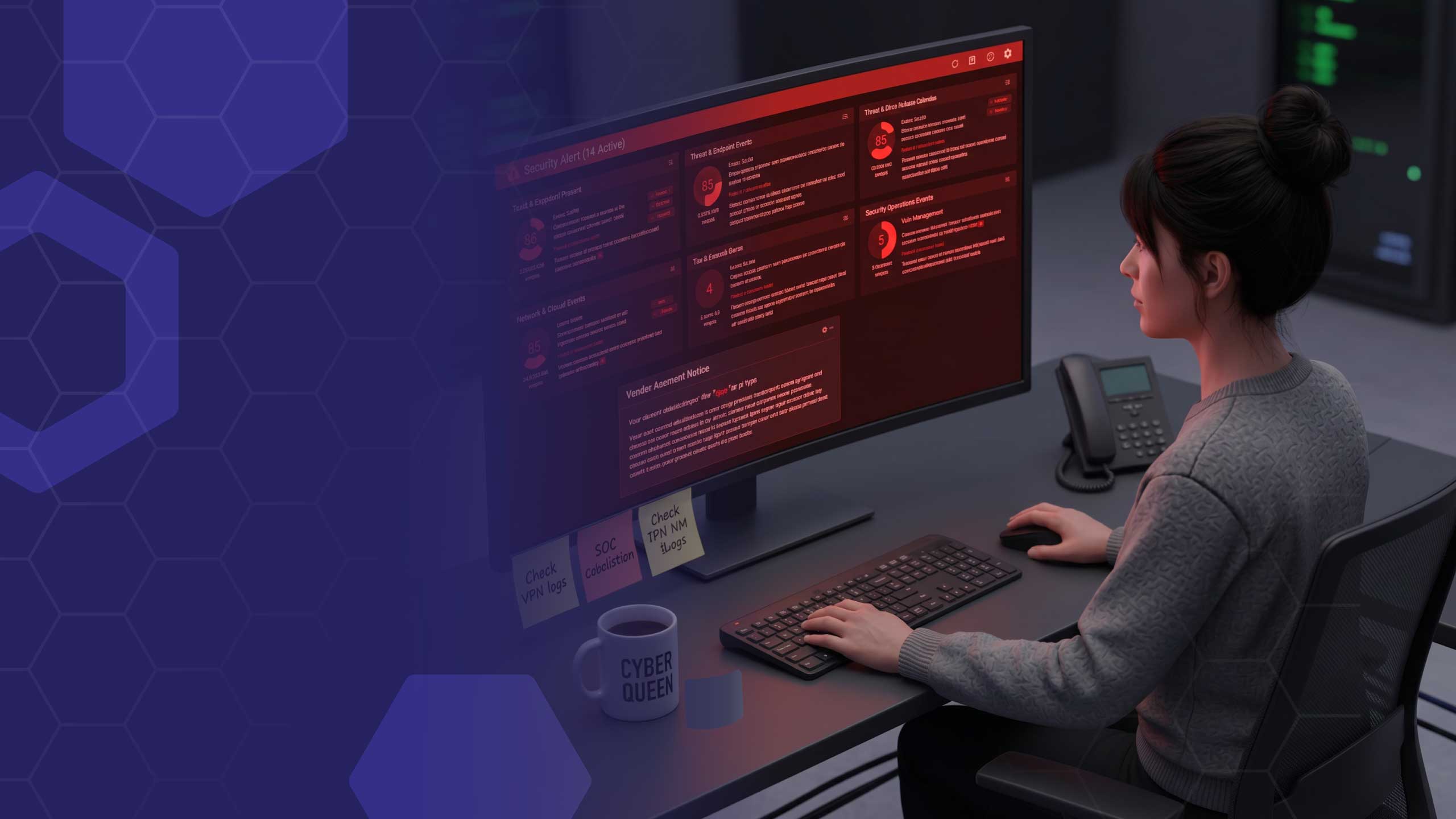
It’s Monday morning. Your inbox has 14 unread alerts from three different security tools, a vendor renewal notice, and a message from finance asking you to justify last quarter’s security spend. This is not a bad week. This is the job now.
For IT managers and directors at small and mid-size organizations, security has quietly become a second full-time role — one with no second person to hand it to. The threats have scaled. The attack surface has expanded. The regulatory pressure is real. The team size has not changed.
What most IT leaders don’t realize is that the tools they’ve accumulated were never intended to be operated by a lean team under time pressure. The problem isn’t commitment, and it isn’t budget per se. It’s architecture. Most lean IT organizations are stuck at the early stages of a well-documented maturity journey — not because they haven’t tried, but because the traditional path from ad hoc operations to predictable, enterprise-grade security assumes a staffing model they’ll never have.
This paper maps that journey. It explains why the traditional path stalls lean teams. And it shows how a different architectural decision — one you can make today — compresses the maturity curve dramatically.
The Maturity Journey Most Organizations Don’t Know They’re On
Security maturity research consistently describes the same progression. At the early stages, organizations have limited capabilities and ad hoc operations: endpoint protection, maybe some vulnerability scanning, no consistent process, no metrics. Performance is reactive by necessity. Visibility is fragmented.
Moving up the maturity curve requires adding capability in specific sequences: broader telemetry, aggregated detection, managed services to scale operations, exposure management, and ultimately automated response and orchestration. Organizations that reach the higher milestones — extended capabilities and predictable operations — can detect and contain threats faster, maintain consistent security posture across complex environments, and demonstrate security performance in business terms.
The problem is that the traditional path from early-stage operations to mature, predictable security was designed for organizations with dedicated security staff, specialist skills, and the budget to assemble a layered tool stack. For lean IT teams managing security as a function alongside everything else, that path is structurally inaccessible.
Research from Gartner notes that “a best-of-breed method for selecting technology can become cost-prohibitive when building a modern security operations center,” and that reactionary, unplanned stack growth “often leads to technology selection that just addresses symptoms, not root causes.”
Source: Gartner, “Choose the Right Tools in Your Security Operations Maturity Journey,” G00803168
This is the trap most lean IT teams are in. Not failing to try — but accumulating tools that address symptoms without fixing the structural problem underneath.
Where Lean IT Teams Actually Get Stuck
Understanding where a lean team stalls requires understanding what the maturity stages actually demand. The early milestones are achievable with off-the-shelf tools and general IT skills. The middle and upper milestones are where the traditional path assumes resources that lean teams don’t have.
Early-stage: Formation and fundamental operations
Most lean IT organizations are at or around the first two milestones of security maturity. They have endpoint detection. They may have some vulnerability management capability. Tools were acquired in response to real problems. The stack exists. But it’s a stack, not a system.
At this stage, the defining characteristic is isolation. Tools don’t share context. Alerts come from multiple consoles with no shared prioritization layer. Each tool was built for a specialist operator, but the person managing it is a generalist with 40 other things on their plate. The coverage exists on paper. In practice, the gaps between tools are exactly where threats move.
Mid-stage: Where most lean teams stall
The next stage on the traditional maturity path requires adding SIEM for aggregated detection and centralized visibility, managed detection and response services to scale operational capacity, extended detection across cloud and SaaS environments, and threat intelligence capabilities beyond what’s built into point tools.
Each of these investments individually is a reasonable idea. Collectively, they require ongoing specialist management that lean teams simply don’t have. The SIEM requires tuning. The MDR service requires active collaboration. The integrations require maintenance. The net effect is that organizations making these investments often end up with more visibility and the same capacity constraints.
Gartner’s maturity research identifies a specific inflection point: “Highly converged solutions service early stages well by offering up a variety of capabilities in different areas within a singular solution platform.” The implication is explicit — for resource-constrained organizations, platform convergence is not a feature preference; it’s a structural requirement for moving forward.
Source: Gartner, G00803168
Coordination is not the same as consolidation. An organization can reduce alert chaos without removing the underlying complexity that creates it. Someone still has to connect the signals, interpret the findings, and decide what to do. When the team doing that is also managing help desk tickets, onboarding new devices, and fielding finance questions, the gap between what the system demands and what the team can deliver is structural, not motivational.
Upper milestones: The capability wall
The higher maturity stages — extended capabilities and predictable operations — represent a qualitative shift. At these levels, organizations are continuously monitoring exposure, running automated detection and response across all environments, gaining visibility into multi-surface attack chains in near real-time for investigations, and using AI to scale operational capacity beyond what headcount alone can support.
Conventionally, reaching these stages requires building out the layers beneath them: SIEM, MDR, advanced threat intelligence, case management, automated controls assessment, and AI assistants, operated by a team with the specialist depth to use them. For a lean IT team of two or three people covering security as one function among many, this roadmap has no realistic endpoint.
A Different Architectural Decision
The reason lean IT teams stall isn’t that they lack ambition or resources. It’s that the conventional maturity path was designed for organizations with dedicated security departments. Every step on that path adds a new tool, a new vendor relationship, a new set of alerts requiring specialist interpretation, and more complexity for the team to carry.
The conventional path builds capability by adding components. A unified platform approach builds capability by replacing the architecture that made the stacking necessary in the first place.
This distinction matters more than it sounds. When a platform brings endpoint, email, network, cloud, and data protection into a unified environment, security teams gain consistent visibility across those domains without managing separate tools and integrations. The operational overhead of maintaining fragmented products is reduced, allowing lean IT teams to investigate incidents more efficiently from a single interface. The manual handoffs between tools disappear. The specialist knowledge required to operate each component independently disappears. What’s left is a security environment that a generalist can manage, performing at a level that was previously only accessible to teams with dedicated SecOps functions.
“A unified platform helps me keep things boring. And when it comes to cybersecurity and dealing with a lot of private information, boring is what you want to be.”
— Kenny Shannon, IT Director
The specific capabilities that characterize higher maturity milestones — automated response, continuous posture monitoring, unified visibility for faster investigation across security domains, consistent policy enforcement within each module across users and devices, AI-assisted detection and resolution — are not inherently dependent on large teams. They are dependent on architecture. When the architecture is unified, those capabilities become accessible at any team size.
What Reaching Upper Maturity Looks Like at Lean Team Scale
Organizations that transition to a unified platform do not simply reorganize their existing tools. They reach a qualitatively different operational state. The following describes what that state looks like across the dimensions that define mature security operations:
Enterprise-grade visibility for lean IT
Multi-surface attacks often span email, endpoint, identity, cloud, and network environments. In a fragmented stack, understanding the full scope requires switching between multiple consoles and manually piecing together what happened. By contrast, on a unified platform, organizations can view activity across those environments from a single interface, making it faster and easier to understand the broader context of an incident. Instead of assembling evidence across disconnected tools, they start their investigation with visibility into the environment.
Continuous posture monitoring, not just reactive alerting
Higher maturity operations are characterized not by faster response speed, but by fewer events requiring response at all. Continuous posture monitoring identifies misconfigurations, policy drift, and exposure gaps before they become incidents. The measure of success shifts from “how quickly did we respond” to “how rarely did we need to.”
People-agnostic security at enterprise scale
Mature security operations encode policy and process at the platform level, not in the institutional knowledge of whoever configured the stack. When that person leaves or is unavailable, the environment continues to perform. For lean IT teams — where security knowledge is often concentrated in one or two individuals — this is not a nice-to-have. It’s the difference between sustainable operations and a single point of failure with a PTO schedule.
Scalable coverage as the business grows
Onboarding a new office, a new SaaS application, or a newly acquired entity into a fragmented stack means extending and integrating more point solutions. On a unified platform, new environments inherit the existing framework automatically. The security posture grows with the organization without growing the operational overhead required to maintain it.
A predictable cost model
Fragmented stacks have fragmented cost structures: multiple vendor contracts, overlapping renewal cycles, and the hidden cost of the team time required to manage them. A unified platform consolidates this into a single, predictable investment — with a measurable ROI that a fragmented stack makes it almost impossible to calculate.
Independent analysis has found that organizations using consolidated security platforms generate four times greater ROI compared to those operating fragmented stacks, and that security automation compresses breach containment timelines by roughly 100 days.
Where You Are, and What Moves You Forward
Most lean IT organizations are not starting from zero. They have tools. They may have some integration between those tools. They have institutional knowledge about their environment, their risks, and their constraints. The question is not whether to build security maturity — it’s whether the next investment extends the existing complexity or begins replacing it.
The table below describes the maturity progression and what operational state corresponds to each level. The Coro platform is designed to deliver the capabilities of Milestones 4 and 5 in an operational model accessible at Milestones 1 and 2.
M1–2: Formation & Fundamental Ops
Point tools operating in isolation. Endpoint protection and basic vulnerability visibility. Alert volumes outpace investigative bandwidth. No consistent metrics or response workflows.
M3: Functional SecOps
Detection scope widens. SIEM aggregates telemetry. Managed services begin to extend operational capacity. Performance becomes a design factor, but specialist skills are still required to operate the stack.
M4–5: Extended & Predictable Ops
Automated detection and response. Continuous exposure management. Unified visibility across security domains. AI-assisted investigation. Consistent posture enforcement within each module. Operations perform predictably regardless of headcount or who is in the seat.
Coro delivers
M4–5 operational capability in an M1 operational model. No specialist staff required. No custom integrations to maintain. No rip-and-replace transition. A lean IT team of two moves from fragmented point tools to predictable, enterprise-grade security operations without adding headcount.
Getting There Without Starting Over
The single biggest misconception about platform consolidation is that it requires a rip-and-replace project — a multi-month migration with operational disruption at every step. For most lean IT organizations, the path forward looks nothing like this.
The practical sequence is: map the current stack, identify which tools are creating operational debt rather than operational value, and replace them with platform coverage in tranches. The goal is not a perfect architecture on day one. It’s progressive consolidation that reduces complexity at each step while maintaining or improving coverage.
Coro specialists work with lean IT teams to conduct exactly this kind of assessment: mapping the current tool environment, identifying where fragmentation is creating gaps, and building a consolidation roadmap that fits how the team actually operates. The 20-minute assessment produces a clear picture of where you are on the maturity curve and what the path forward looks like.
“I can’t afford to hire somebody entirely focused on security. A unified platform gives me security while also allowing me to control my spend.”
— Jerry Wilson, Director of Educational Support
This is not a migration project. It is a capability acquisition — one that returns operational capacity to the team instead of consuming it. From that position, security scales with the business, personnel transitions don’t create risk, and the maturity curve that was previously inaccessible to lean IT becomes a path you’re already on.
See What Your Maturity Path Looks Like
Coro is built for this journey. It is a unified cybersecurity platform purpose-built for lean IT teams — not an enterprise tool repurposed for smaller organizations, but a platform designed around how this work actually gets done.
Book a 20-minute customized assessment with a Coro security specialist. We’ll map your current stack against the maturity framework, identify your highest-priority consolidation opportunities, and show you exactly what the path to predictable operations looks like for your team.