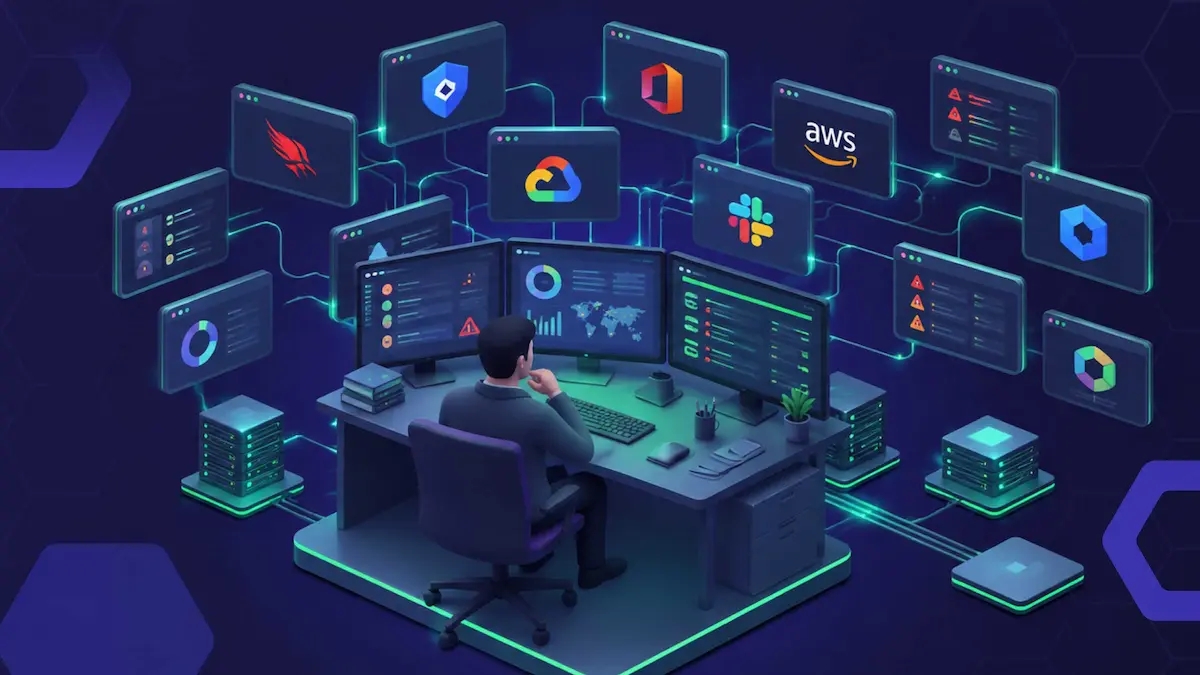
Gartner® finds that “63% of CISO leaders identify technical debt/legacy systems as their largest pain point posing significant challenges to CISO priorities..”[1] Most fragmented environments share a similar backstory: a merger that folded someone else’s tools into yours, a leadership change that handed off contracts and configurations nobody explained, a predecessor who bought each tool to solve the problem in front of them without an integration strategy tying the purchases together.
None of that makes the fragmentation your fault. It just makes it your problem now.
The stack nobody designed
Fragmentation like this happens because security gets built one incident at a time. Each purchase solves the problem in front of it, and the stack accumulates faster than anyone can rationalize it.
Gartner reports that” Because large enterprises use an average of 43 security tools , cybersecurity leaders are looking to reduce the number of security vendors in their network security protection portfolio. “.[2]Gartner notes “Beyond the “double license,” overlapping tools often generate duplicate alerts (including false positives), contributing to the alert fatigue and blurring the real picture of threats. “.”[3] Gartner also projects that by 2028, the average enterprise will waste 35% to 40% of its total SOC budget on these overlapping costs.[3] If your organization has no SOC to speak of, that waste doesn’t disappear. It just comes out of your team’s hours instead of a budget line, the alert noise included.
For a Lean IT team, that overlap is the difference between a Tuesday spent investigating real threats and a Tuesday spent reconciling three different alerts about the same login.
Outcomes before costs
When leaders do rationalize an inherited stack, they usually do it for one reason: cost. That’s often how the current mess got made. Someone cut the cheaper tool instead of the redundant one, or consolidated licenses without considering how the team actually worked.
Gartner’s guidance runs the other direction. The firm’s platform-consolidation research advises organizations to make security outcomes and posture improvement the primary objective, treating cost savings as what follows rather than what leads.[4] Teams that optimize for cost first tend to land back in a fragmented stack a few years later.
Before you can improve your architecture, you need a clear picture of the one you’ve inherited. Gartner’s cost-optimization research notes that “cybersecurity leaders struggle to extract the full value of existing tools due to underutilization.”[5] An inventory is how you find out where that’s happening in your own stack. The goal isn’t to rip and replace. It’s to understand what you have before deciding what should change.
What workspace cybersecurity looks like
If posture and operational efficiency are the goal, the next question is what architecture actually delivers them.
Gartner defines a workspace cybersecurity platform (WCP) as “a set of modular, preintegrated product capabilities designed to protect endpoints, identities, applications and data of modern digital workers.”[6] In practice, that means one console and one data model in place of a dozen disconnected ones.
Here’s an important reminder: integration is not unification. A SIEM may connect your tools after an event occurs, but every tool still maintains its own policies, data model, and limited view of your environment. Six tools still means six consoles, six data models, and six sets of policy enforced inside six boundaries. Each tool only knows what happens inside itself. Your endpoint tool has no visibility into your email environment. That gap is structural, not a configuration problem you can solve with more integration work.
Every instance of overlap isn’t inherently bad. Gartner finds that “organizations tend to consolidate where they can afford to eliminate best-of-breed functionality”[4] without significant drops in efficacy. The challenge is understanding which overlap strengthens your security posture and which simply adds operational complexity.
A workspace cybersecurity platform closes these gaps by starting from a single data model, so context stops fragmenting at each tool’s boundary. The operational gains follow from the architecture rather than from any individual feature: fewer consoles to monitor, one policy layer to enforce, prebuilt integrations instead of a custom pipeline someone has to maintain. That shift is already underway. Gartner projects that by 2030 “cybersecurity platforms will replace ‘best of breed’ siloed buying for 75% of organizations.”[7]
While the scale varies by environment, here’s what the shift tends to look like for a lean team consolidating a dozen-plus tools:
Inherited Stack
Workspace Cybersecurity Platform
12–15 admin consoles to monitor
1 unified console
4–6 endpoint agents competing for resources
1–2 coordinated agents
Duplicate alerts from overlapping tools
Overlapping tools removed, so the duplicates stop
1–2 weeks to roll out a policy change
1–2 days
2.5 FTE tied up managing tool sprawl
0.5–1.0 FTE
~$325K in annual overhead
~65K-130K
In this scenario, roughly $195,000 to $260,000 comes back each year. Time and budget that used to go into managing the stack becomes available for the security work it was supposed to enable in the first place.
Three tests for a unified platform
Evaluating platforms gets simpler once you stop comparing feature lists and start asking a single question: does this security layer have access to everything at once, including users, policy, events, logs, and configuration? In a stack built from point solutions, the answer is always no, because no single tool holds the full picture.
From there, three tests tell you whether a workspace cybersecurity platform will hold up.
It has to be operable by a generalist. Detection, triage, and remediation need to work without someone authoring correlation rules or maintaining a playbook on the side.
It has to reduce console-hopping. When a threat needs investigating, your team should be able to filter one interface by user or device and see the related activity across email, endpoint, identity, and data, instead of pulling logs from separate tools and piecing the sequence together by hand. That alone turns an hours-long investigation into a matter of minutes.
It has to survive people leaving. If the reasoning behind a configuration lives in one person’s head, it walks out the door the day they do. When posture is defined in the platform and stays there, a new IT lead inherits a working environment instead of a fragmented stack.
That’s what workspace cybersecurity delivers: endpoint, email, identity, and data protection that behaves like one system your team already understands.
Turn inherited chaos into clarity
You didn’t build the stack you inherited. But you can transform it. What you control is how you architect what comes next, and how much friction your team absorbs getting there.
Consolidation isn’t a weekend project. Gartner’s platform-consolidation research describes it as a multiyear undertaking, noting that most organizations in its research pursued consolidation for three years or more.[4]
If you’re evaluating what consolidation would actually take, start with the practical questions: how long implementation runs, what breaks during migration, what your team has to learn on day one versus month three, and what “pre-integrated” means.
Our guide, “5 Ways to Reduce Implementation Time for Security Tools,” walks through exactly that.
Sources
[1]Gartner Report, “Top 4 Head of I&O and CISO Partnership Areas, By Ron Blair, Dionisio Zumerle 25 March 2025
[2] Adam Hils, Charanpal Bhogal, “Maximize Network Security Platform Investments by Enabling Advanced Features,” Gartner, 23 March 2026, ID G00840633. https://www.gartner.com/document-reader/document/7628829?ref=askgartner-copy
[3] Carlos De Sola Caraballo, “Manage SOC Tool Overlap to Avoid Hidden Expenses,” Gartner, 9 March 2026, ID G00845523. https://www.gartner.com/document-reader/document/7570281?ref=askgartner-copy
[4] Dionisio Zumerle, John Watts, “Simplify Cybersecurity With a Platform Consolidation Framework,” Gartner, 26 March 2024, ID G00781423. https://www.gartner.com/document-reader/document/5314263?ref=askgartner-smart
[5] Aanchal Mair, Nathan Parks, “3 Steps to Cost-Optimize Your Cybersecurity Technology Portfolio,” Gartner, 15 October 2025, ID G00834450. https://www.gartner.com/document-reader/document/7074498?ref=askgartner-smart
[6] Evgeny Mirolyubov, Peter Firstbrook, “Market Overview for Workspace Cybersecurity Platforms,” Gartner, 20 July 2026, ID G00836743. https://www.gartner.com/document-reader/document/8149229?ref=askgartner-copy
[7] Peter Firstbrook, “5 Steps to Rationalizing Your Cybersecurity Technology Stack by 2030,” Gartner, 7 July 2026, ID G00844557. https://www.gartner.com/document-reader/document/8102497?ref=askgartner-copy
GARTNER is a registered trademark and service mark of Gartner, Inc. and/or its affiliates in the U.S. and internationally and is used herein with permission. All rights reserved. Gartner does not endorse any vendor, product or service depicted in its research publications, and does not advise technology users to select only those vendors with the highest ratings or other designation. Gartner research publications consist of the opinions of Gartner’s research organization and should not be construed as statements of fact. Gartner disclaims all warranties, expressed or implied, with respect to this research, including any warranties of merchantability or fitness for a particular purpose.